Canadian Grand Prix Circuit Overview

Updated 09 Jul, 2026


The Canadian Grand Prix takes place at Circuit Gilles Villeneuve, a semi-permanent street circuit built on the man-made Île Notre-Dame in the St. Lawrence River, Montreal. The circuit has hosted the Canadian Grand Prix since 1978, when it was renamed in honour of the legendary Québécois driver Gilles Villeneuve following his death in 1982.
Drivers and fans consistently rank it among the most exciting venues on the calendar. This low-downforce power circuit that punishes mistakes but rewards aggression has produced some of the sport's most dramatic finishes.
Unlike the sweeping, high-speed layouts of Suzuka or Silverstone, Circuit Gilles Villeneuve is built around long straights connected by tight chicanes and a heavy-braking hairpin. Its most iconic feature is the Wall of Champions at the final chicane. A concrete barrier that has ended the races of Damon Hill, Michael Schumacher, Jacques Villeneuve, and Sebastian Vettel, to name a few.

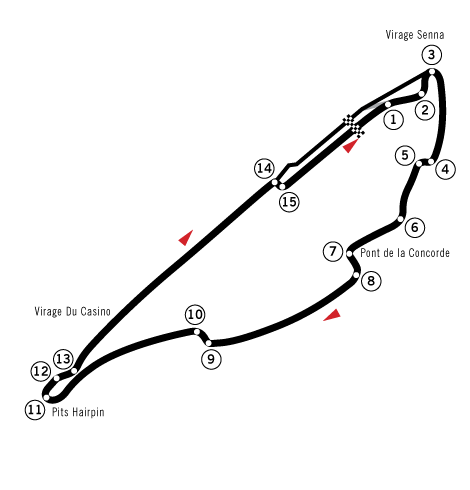
| Circuit | Circuit Gilles Villeneuve |
|---|---|
| Location | Montreal, Quebec, Canada |
| Circuit Type | Semi-permanent street circuit |
| Lap Length | 4.361 km |
| Corners | 14 |
| Race Distance | 70 laps |
| Race Lap Record | 1:13.078 – Valtteri Bottas (2019) |
Canadian Grand Prix
Circuit Gilles Villeneuve is a stop-start power circuit where braking stability, traction, straight-line speed, and managing the FIA's energy limits all matter.
Lap Length
4.361
Kilometers per lap
Race Distance
70
Laps around Île Notre-Dame
Corners
14
Mostly chicanes and slow exits
Circuit Type
Semi
Semi-permanent street circuit
Overtaking
High
Braking Demand
Very High
Tire Stress
Medium
Safety Car Risk
High
The circuit's stop-start character sets it apart from most of the calendar. Braking stability and traction out of tight corners matter far more here than aerodynamic efficiency through fast sweeps. Cars run low-downforce configurations to take advantage of the long straights, but that trade-off demands absolute precision in the braking zones, particularly at the hairpin and through the chicanes.
1
The FIA slashed the qualifying harvest limit from 8MJ down to 6MJ per lap. Drivers must perfectly meter their recovery or risk running out of battery.
Biggest 2026 factor
2
Sectors 1 and 2 offer easy harvesting, but the long run down the Casino Straight requires massive deployment with no chance to recharge.
Energy starved
3
Montreal hosts its first Sprint weekend. Teams have only a single 60-minute practice session to dial in complex engine mappings and setups.
Zero margin for error
Formula 1's 2026 technical overhaul has turned Circuit Gilles Villeneuve into an asymmetric energy nightmare. The new 50/50 hybrid power units will be pushed to their absolute limits by the track's layout.
The primary issue is the strict 6MJ per lap harvesting cap enforced by the FIA for qualifying. The first half of the lap features a run of heavy-braking zones and short straights, making it incredibly easy to recover energy. However, the final sector demands massive electrical deployment with almost zero opportunity to recharge.
Drivers must actively manage their harvesting early in the lap. If they hit the 6MJ cap too soon, the hybrid system shuts off recovery entirely. That leaves them completely energy-starved and vulnerable to massive speed deficits down the back straight toward the Wall of Champions.
Complicating matters further, the 2026 Canadian Grand Prix is a Sprint weekend. Teams will have just a single 60-minute free practice session to perfect these complex energy deployment algorithms and lock in their suspension setups over the aggressive kerbs before parc fermé conditions begin.
The Canadian Grand Prix lap is less about flowing rhythm and more about repeated execution: brake late, rotate the car, protect traction, then launch onto the next straight.
Sector 1
The first sector demands clean braking and confidence over the kerbs. A poor exit compromises the next straight immediately.
Sector 2
The hairpin is the key traction zone. Drivers who rotate the car cleanly can carry speed all the way onto the long run back toward the pits.
Sector 3
The lap ends with the biggest risk-reward sequence: maximum speed down the straight, then absolute precision at the final chicane.
Circuit Gilles Villeneuve is one of the most distinctive layouts on the F1 calendar. It is part street circuit, part power track, and all unforgiving. The lap flows through three distinct phases: the twisty opening sector around the island's road network, a mid-section defined by the sweeping right-left chicane complex and the tight Épingle hairpin, and the Casino Straight run that ends at the Wall of Champions.
Key characteristics include:
Tire degradation here is driven more by high traction loads out of slow corners than by sustained lateral stress. The repeated acceleration-and-braking cycle is hard on rear tires in particular, and teams that can protect their rubber through the opening stint often benefit from strategic flexibility later in the race.
Weather is a real factor in Montreal. Rain is common at this time of year and the circuit's surface, built partly on public roads, can become extremely greasy in wet conditions. A safety car is more likely here than at almost any other round on the calendar, and that shapes strategy as much as any tire calculation.
Montreal produces some of the most unpredictable races on the calendar. Safety cars pile in regularly, strategy calls are forced mid-plan, and the Wall of Champions takes at least one notable victim most years. Under the 2026 regulations, the restricted energy recovery limits mean drivers must carefully map their electrical boost. A driver who can efficiently manage their harvesting early in the lap will carry a massive, un-defendable speed advantage down the Casino Straight.
Track position matters, but this is one of the few circuits where DRS and raw electrical deployment create genuine passing opportunities even for drivers starting outside the top five. It's also one of the few places where a driver running second can pressure the leader into a mistake at the final chicane. The Wall doesn't just catch the careless; it catches the pressured.
Race Strategy Dashboard
Montreal is one of the few circuits where race strategy can change quickly. With the 2026 Sprint format limiting practice time, getting the tire and energy models right from lap one is crucial.
Very Important
With just one 60-minute practice session, teams risk starting the weekend with sub-optimal ride heights over the aggressive kerbs or flawed tire models.
Very Important
Incidents are common because the walls sit close to the racing line. A well-timed safety car can turn a conservative strategy into the winning call.
High Impact
The 6MJ harvest cap means drivers must perfectly meter their electrical recovery in Sector 1 so they don't run dry out of the hairpin.
High Impact
Traction out of slow corners matters more than long-corner tire loading. Teams that protect the rears can extend stints and stay flexible.
Strategy read: Montreal rewards aggressive teams, but only if they remain adaptable. The fastest pre-race plan is not always the right one once safety cars, rain, or a battery deficit enter the equation.
Because of the safety car risk, limited practice data, and genuine overtaking possibilities, teams at Montreal have more reason than usual to play an aggressive strategy. An early undercut can work, but a well-timed reaction to a virtual safety car often decides the result. Racing here under the 2026 regulations rewards technical adaptability as much as raw pace.
Who gets caught by the 6MJ cap?
Watch for drivers suddenly losing straight-line speed on the run to the final chicane. If they harvest too much energy early in the lap, the hybrid system stops recovering, leaving them vulnerable down the Casino Straight.
Can teams nail the setup in 60 minutes?
The Sprint format means just one free practice session. Teams that miss the setup window will struggle with ride quality over the bumpy braking zones and aggressive kerbs all weekend.
Does the race get interrupted?
Safety cars are always part of the Montreal conversation. Walls, chicanes, and unpredictable weather can force teams away from their planned strategy within seconds.
Who protects the rear tires best?
Montreal is rear-limited because of repeated acceleration from slow corners. Drivers who avoid wheelspin early in the stint often gain more strategic freedom later.
Affiliate DisclosureATS.io uses affiliate links. If you sign up through a link on this page, we may earn a commission at no additional cost to you. Rankings are based on hands-on testing and published criteria, and affiliate relationships do not determine placement.